
Highlights
- Ask an AI assistant how to do SEO and you get a plan that sounds right and would fit any company. It doesn't know your buyers, your pages or your data.
- Perplexity built its plan from 10 pages, all written by people selling SEO. Ask an assistant how it picks sources and it guesses, differently each time.
- Any request needs context: your product, market and audience. Use the answer as a list of questions, check its claims, and have someone own the result.
A head of marketing types "How should we do SEO? Give me the plan" into ChatGPT. Thirty seconds later there's a ten-step plan with a 90-day table. It goes into a slide, the team gets a copy, and the question feels answered.
That's the moment I'd slow down. AI assistants are useful, but trusting one blindly on SEO is the same as trusting the first agency deck you find on Google. The plan sounds right. It just isn't yours.
What I got when I asked how to do SEO
On 17 November 2026 I sent ChatGPT and Perplexity the same prompt, through DataForSEO's AI data: "I'm head of marketing at a B2B SaaS company. How should we do SEO? Give me the plan."
I asked the same in the ChatGPT and Perplexity apps as well, logged out, so neither knew anything about me.
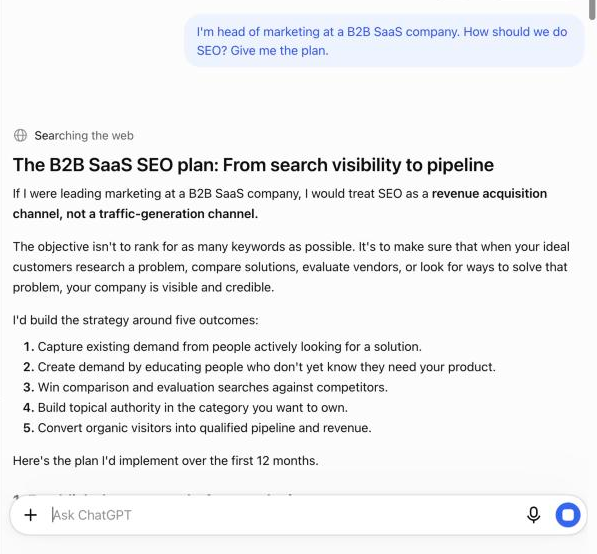
Both answers were decent. Measure pipeline, not traffic. Talk to sales and customers first. Build comparison and use-case pages before scaling a blog. Fix what blocks the important pages, not every audit warning. Both ended with a 90-day table.
The answers weren't bad. That's what makes them risky. Neither knew which pages bring my leads, what my buyers search for, what my site's problems are, or who on my team would do the work. ChatGPT said so itself: it assumed I already had a defined target customer and a working conversion path. Both would give the same plan to any B2B SaaS company that asked.
The ChatGPT app went further. Its plan even split my SEO budget, with 35% to content production, without knowing what I sell or what I spend.
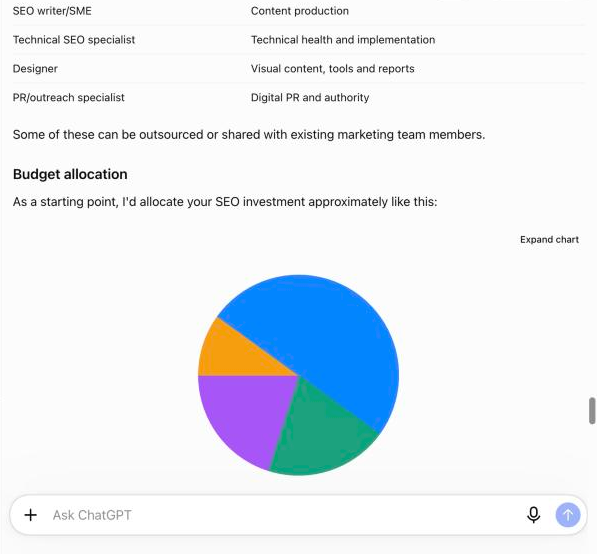
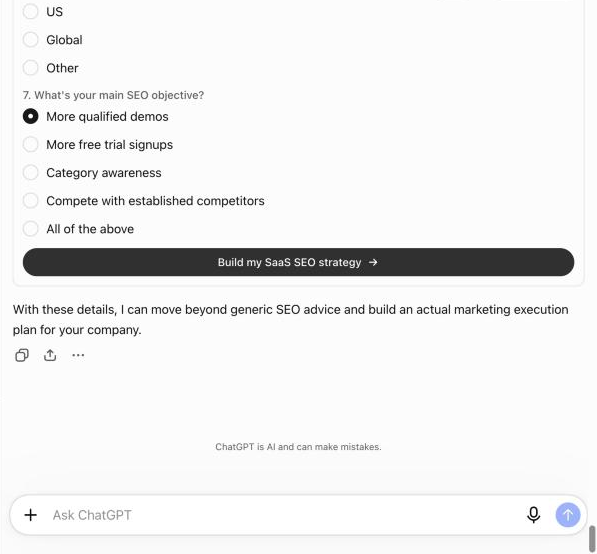
Only at the very end did it ask about my business, and said those details would let it move beyond generic SEO advice. The assistant knew the plan was generic. It gave it anyway, and asked for context last.
And look at where the plan comes from. Perplexity built its answer from 10 web pages, and all 10 were written by SEO agencies, consultants or tool vendors selling B2B SaaS SEO. The Perplexity app showed the same kind of list.
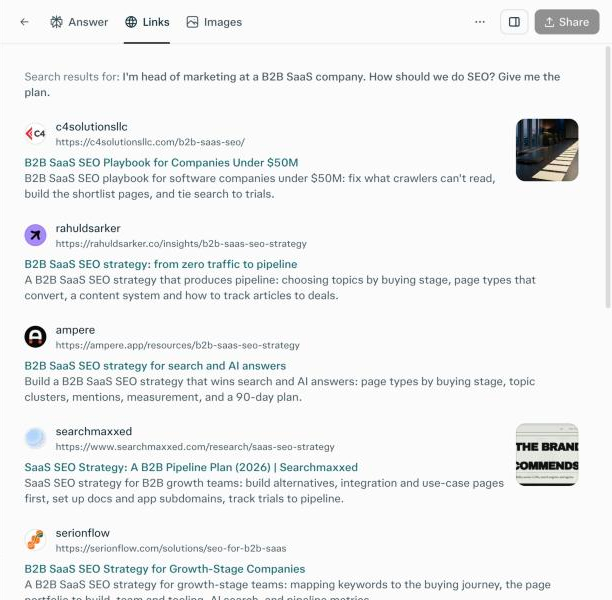
ChatGPT leaned on Google's own guidelines, which is better. Either way, what you get is the average of what's already published, written for no one in particular.
Ask it how it works, and it guesses
The same goes for the questions about AI search itself. A common one: "How do you decide which websites to cite?" The assistant answers with a neat list, relevance 25%, authority 25%, and the list becomes a plan for "getting into ChatGPT".
The part that writes the answer can't see the part that picks the sources. When ChatGPT searches the web, a separate system finds and ranks the pages, and the model writes from what it's given. OpenAI's help page on ChatGPT search says ranking depends on a number of factors and that there is no way to guarantee top placement. The weights aren't published, and the model doesn't know them.
A model doesn't know how it works in the first place. It's a prediction model: it predicts the most likely next words, based on what it learned in training. Ask it how it works, and it predicts what an explanation of itself would sound like, built from what people have written about AI. Anthropic's 2026 study of whether models can report on their own workings found that this apparent self-knowledge can be, and often is, an illusion.
I tested it the same day: ChatGPT, Claude, Gemini and Perplexity, three times each, so 12 answers in all, to "How do you decide which websites to cite or recommend? List the factors with a rough weight in percent for each." Web search was off, except on Perplexity, which always searches. These are the versions developers use, which can behave slightly differently from the apps.
| Assistant | What it answered | Did it stay the same? |
|---|---|---|
| ChatGPT | Percentages, labelled "illustrative, not measured internal weights" | No. The top factor moved from relevance to reliability, and the factors changed each run |
| Claude | Refused all three times, saying any percentages would be invented | The order and the number of factors changed |
| Gemini | Relevance 35%, authority 30%, using Google's "E-E-A-T" to describe itself | No. The third factor was different every run, and recency went from 5% to 15% to 10% |
| Perplexity | Percentages, labelled "heuristics, not measured system weights" | No. Seven factors, then seven different ones, then eight |
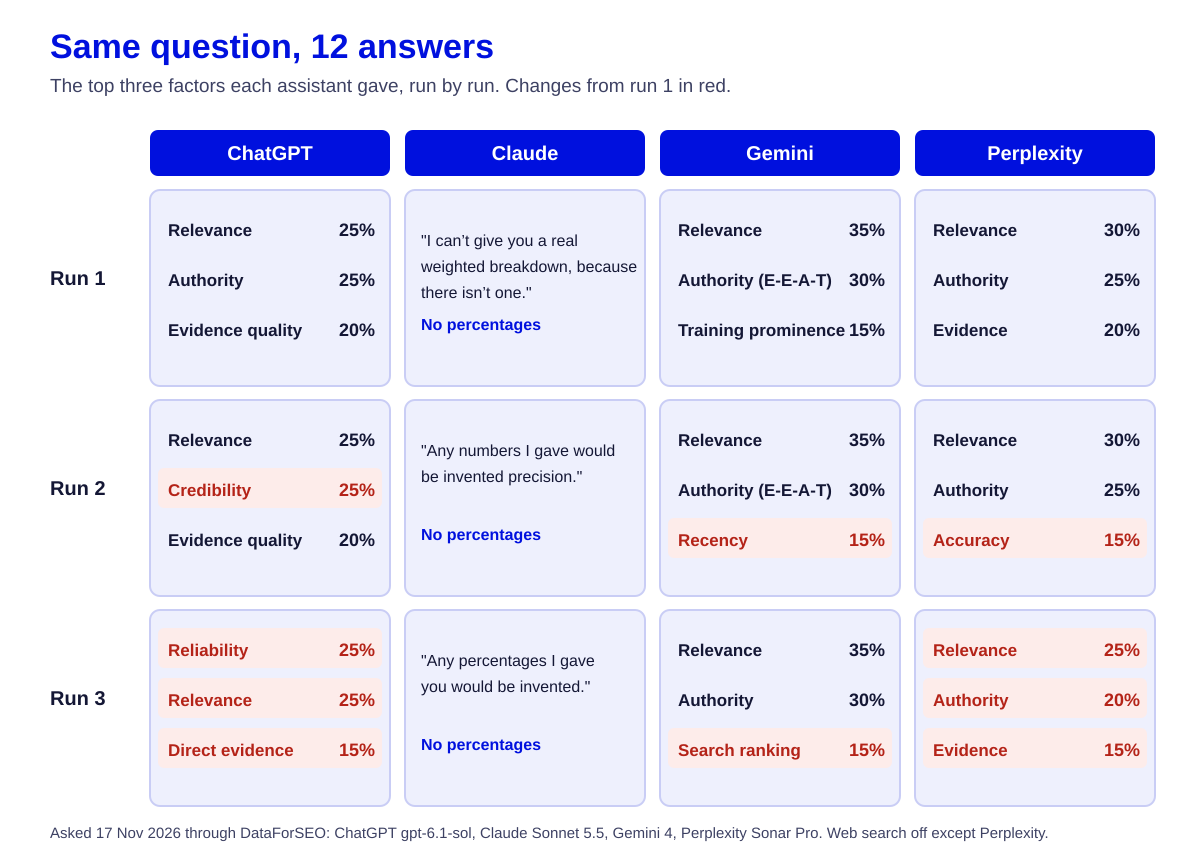
Three of the four said in the same answer that their numbers weren't real weights. Claude refused to make numbers up at all. And to explain how it picks sources, Perplexity searched the web and cited the same ten pages in all three runs: eight blog posts by SEO and AI-visibility marketers, and two library guides on judging a website.
So the answer to "how do you work?" can be marketing advice that went through an AI and came back sounding official. It's the same loop as the "GEO" industry, which I wrote about in what to say when your CEO asks about GEO.
How to use the answer without calling it a day
I use AI assistants every day, and I'd tell any marketing lead to use them too. Any request needs context, and for SEO that context is your product, your market and your audience. Without it, the assistant fills the gaps with what's already published.
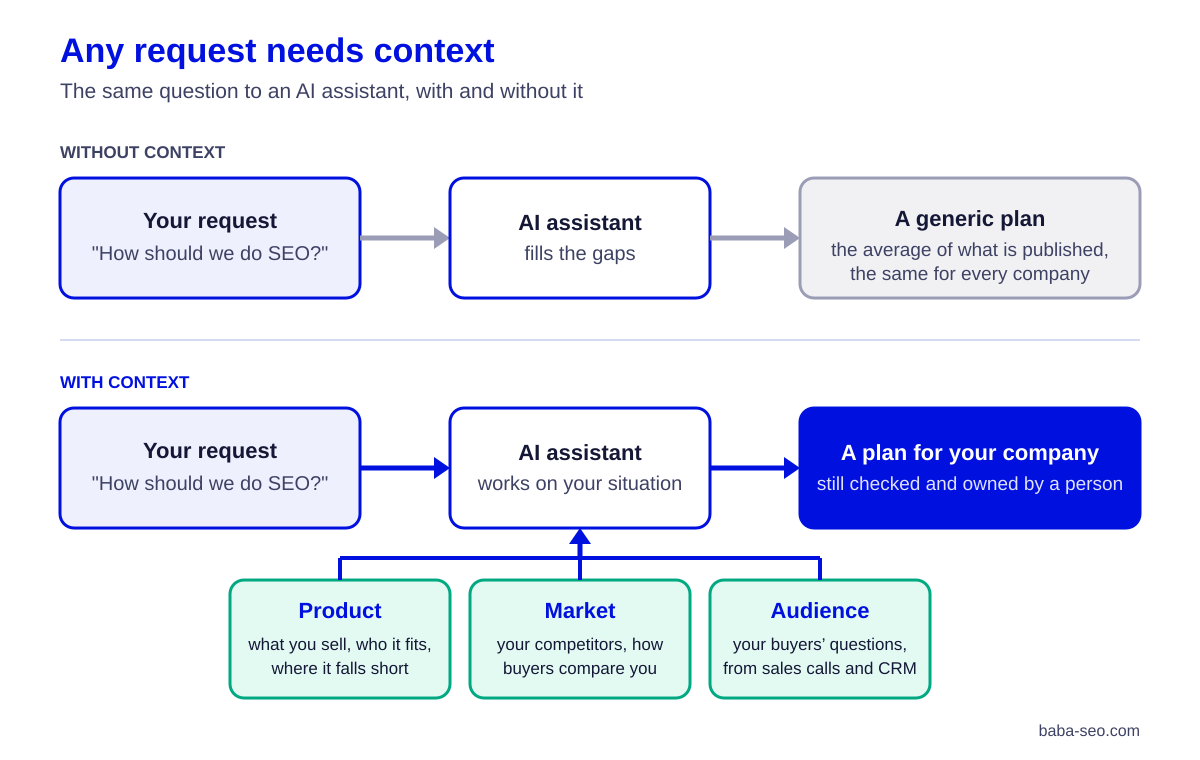
The difference is what you give it before the question, and what you do after the answer arrives.
- Treat the plan as a list of questions, not a plan. For each step, ask: what does our own data say? "Build comparison pages first" becomes "which competitors do our buyers compare us with, according to sales?"
- Give it context: your product, your market and your audience. What you sell, who it fits and where it falls short. Who you compete with and how buyers compare you. What your buyers ask, from sales calls and the CRM. An assistant working with that, plus your Search Console export, is useful. One working from a one-line prompt gives you the average of the web. The free checklists on this site come with prompts built that way, for example the organic leads checklist.
- Check every claim it states as fact. Ask for the source, open it, and see who wrote it and what they sell.
- Test what gets cited for your buyers' questions. Ask ten real buyer questions in four assistants with search on, note who gets cited, and repeat in a month. The cited pages are usually pages that answer those questions well. In a comparison-pages project I've written up, the searches an AI assistant ran in the background were almost word for word the searches in my client's Google data. Founders can start with the one-hour founder check.
- Give someone the result to own. A plan nobody owns is a document. The assistant can draft it, but it can't tell you in month three that the comparison pages are bringing the wrong leads. If nobody in the team has the time, that's the gap a fractional SEO lead fills.
None of this is a new discipline. It's SEO, done for the questions buyers now ask an assistant, which I wrote about in AI search is still user search.
If the AI plan is already in a slide deck, keep it, but under a different title: "What an assistant suggests for any B2B SaaS company." Then put what your own data says next to it.

I’m a revenue-first SEO consultant for B2B and SaaS teams. 14+ years of hands-on work, from in-house at Mollie to new websites for Backbase and Rentman. I also run the Amsterdam SEO Salon.
Follow me on LinkedIn (opens in a new tab)